How Much Does It Cost to Run a Retreat? A Line-by-Line Breakdown for Retreat Leaders
How Much Does It Cost to Run a Retreat? A Line-by-Line Breakdown for Retreat Leaders
A 10-guest, 5-night retreat typically costs between $18,000 and $38,000 to deliver at hospitality-grade quality, depending on venue tier, destination, and team size. The largest cost lines are venue and F&B (40–55%), leader and team travel (10–20%), marketing (8–15%), staffing (8–12%), materials and welcome experience (4–8%), and contingency (5–10%). The retreat leaders who clear 30–50% net margin are the ones who know every line of this spreadsheet before the venue contract is signed.
The Line-by-Line Cost of a Retreat
Every profitable retreat business runs on a cost model that accounts for every dollar before the first guest books. The categories below are the standard line items, the ranges assume a 10-guest, 5-night retreat delivered in a well-chosen international or boutique domestic venue.
1. Venue and Food & Beverage: 40–55% of Total Cost
This is the single largest line and the one most often mispriced. A hospitality-grade venue typically bundles rooms, meals, meeting space, and on-site activities into a per-person, per-night package that ranges from $180 to $600 depending on tier and geography.
For a 10-guest, 5-night retreat, expect: $9,000–$30,000. The variance is almost entirely about negotiation, the same property will quote rack rate to one leader and 35% below rack to another who knows how to ask.
Negotiable line items inside the venue contract: F&B minimum, complimentary leader rooms, complimentary upgrades for key guests, release clauses, and payment terms.
2. Leader and Team Travel: 10–20% of Total Cost
Flights, ground transport, and lodging for the leader and any co-facilitators or staff. Running an international retreat from a US base typically adds $2,500–$6,000 per team member depending on destination.
Budget tip: fly in at least 48 hours before guests arrive for venue walk-through, staff briefings, and last-mile problem solving. This is non-negotiable for hospitality-grade delivery.
3. Marketing and Enrollment: 8–15% of Total Cost
This line is often missed entirely by first-time retreat leaders. Every cohort should absorb a portion of the marketing spend that produced it, ad costs, email platform fees, sales page hosting, designer fees, and the pro-rated cost of any content used in the funnel.
For a 10-guest retreat, expect $1,500–$5,000 in directly attributable marketing cost.
4. Staffing and Assistants: 8–12% of Total Cost
Hospitality-grade retreats run with a staff-to-guest ratio of at least 1:4. This means one lead facilitator plus at least one retreat manager or assistant for every 10 guests. Budget $1,500–$3,000 per staff member for a 5-night delivery, plus their travel.
5. Materials and Welcome Experience: 4–8% of Total Cost
Welcome kits, journals, session materials, branded gifts, on-site printing. A hospitality-grade welcome kit runs $75–$150 per guest. For 10 guests, expect $750–$1,500 in materials plus $500–$1,500 in session and ceremony supplies.
6. Contingency: 5–10% of Total Cost
Non-negotiable. Currency swings, last-minute guest cancellations, replacement flights, equipment failures, medical needs, something always comes up. A well-run retreat holds back 5–10% of gross revenue as contingency and treats it as cost until the cohort closes.
7. Insurance, Legal, and Payment Processing: 2–4% of Total Cost
General liability coverage, event cancellation insurance, payment processor fees (2.9% + 30¢ per transaction on most platforms), and any required legal review of guest agreements.
Sample Cost Breakdown: 10-Guest, 5-Night International Retreat
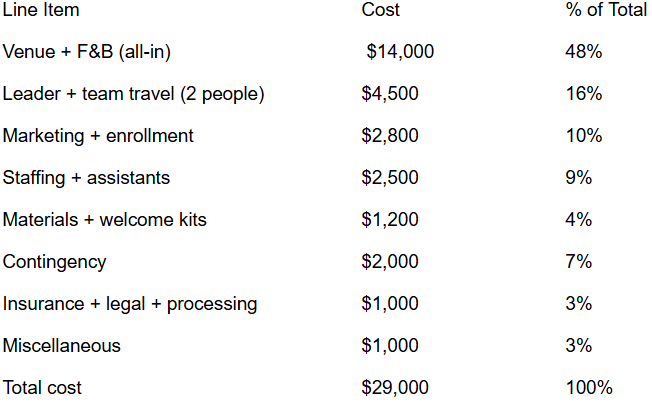
At a $4,500 price point and 10 guests, gross revenue is $45,000 and net profit is $16,000; a 36% margin. That is a profitable retreat.
Where Most Retreat Leaders Get the Cost Wrong
The most common cost modeling mistakes are predictable, and all of them are avoidable.
They forget the marketing line entirely. If a retreat does not absorb its marketing cost, the business is subsidizing itself.
They quote venue at rack rate. First conversations with venues are always the worst rate. Professional retreat leaders negotiate 15–35% off the initial quote.
They forget contingency. Running without contingency means the first refund or emergency turns a profitable retreat into a break-even or losing one.
They do not pay themselves. The leader's time is not free. A retreat that clears $8,000 in net profit after 400 hours of work is paying $20 an hour.
Frequently Asked Questions
What is the minimum cost to run a profitable retreat?
For a small-cohort retreat of 8–10 guests at a well-negotiated boutique venue, a profitable delivery can be built on $15,000–$20,000 in total cost, provided pricing, positioning, and enrollment are architected correctly.
How do I estimate venue cost before getting a quote?
Most boutique and hospitality-grade retreat venues price between $180 and $450 per guest per night all-in. Multiply that by your cohort size, number of nights, and a 10% buffer for variable add-ons.
Should I pay myself a salary from each retreat?
Yes. Always. A retreat leader's time is the most expensive resource in the business. A profitable model includes founder compensation as a line item, separate from net profit.
What percentage of a retreat's revenue should go to marketing?
For an established retreat business, 8–15% of gross revenue is a healthy marketing line. First retreats often need to absorb a higher percentage because the enrollment infrastructure is still being built.
Do I need to buy event cancellation insurance?
For international retreats, yes. It is a small percentage of total cost and protects against force majeure, venue failure, and guest cancellations that would otherwise land on the business.
Want a full retreat cost model tailored to your cohort and venue? Book a strategy call with Leni.