How to Handle Difficult Guests at a Retreat
How to Handle Difficult Guests at a Retreat
Every retreat will have at least one difficult guest. The question is not whether, but how the business handles it. The retreats that maintain hospitality-grade standards do three things: they screen guests well before arrival, they have a clear code of conduct in the guest agreement, and they have a protocol for on-site intervention that does not require the leader to improvise. This is the framework.
What Counts as a "Difficult Guest"?
A difficult guest is any guest whose behavior, intentional or not, disrupts the cohort experience, the venue, or the leader's ability to deliver the retreat.
Common patterns: aggressive questioning, emotional spiraling, conflict with other guests, substance misuse, boundary violations, public criticism of the retreat, or refusal to follow retreat protocols.
The 3-Layer Approach
Layer 1: Screening Before Arrival
The best handling of difficult guests happens before they book. Screening starts with the enrollment form, asking about expectations, prior retreat experience, any mental or physical health considerations, and what the guest hopes to leave with.
For higher-tier retreats, a 20–30 minute strategy call before deposit is non-negotiable. This is where you catch mismatches in expectation and avoid the bookings that become problems.
Layer 2: Code of Conduct in the Guest Agreement
Every guest agreement should include a clear code of conduct with grounds for removal from the retreat. This is not optional.
Minimum clauses:
- Respect for other guests, staff, and venue
- No substance misuse (specific policy)
- Willingness to participate in scheduled sessions
- Acknowledgement that removal is possible for repeated violations
- No refund in the event of removal
The existence of the clause prevents most problems. The rare cases where it is needed, it is legally essential.
Layer 3: On-Site Intervention Protocol
When friction happens on-site, and it will, the leader needs a protocol, not improvisation. The protocol has three stages:
1. Private conversation. Pull the guest aside, name what you observed, ask what is going on for them. Most difficulty resolves here.
2. Clear behavioral request. If the pattern continues, a clear, kind, unambiguous request: "I need you to [specific behavior] for the rest of the retreat."
3. Removal, if necessary. If the pattern continues or escalates, removal per the guest agreement. This should happen rarely (once every 20–40 retreats) but must be possible.
Common Situations and Responses
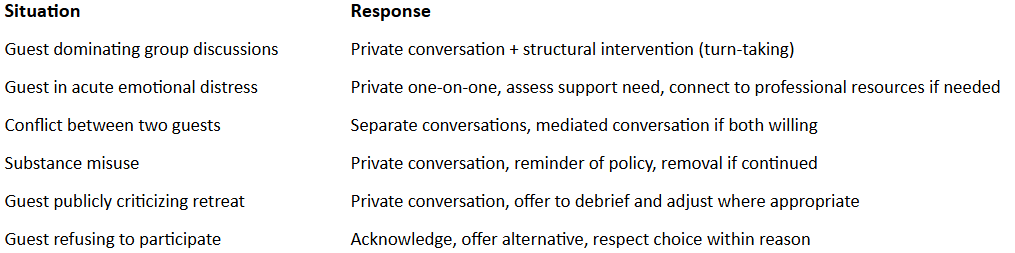
What the Leader Should NOT Do
- Improvise major decisions alone, consult the assistant or team
- Make public examples of difficult guests
- Offer refunds to avoid conflict (this trains the behavior)
- Hold one-on-one sessions in private spaces without a team member aware
- Promise things that are not in the original offer to smooth things over
- Take the behavior personally
Frequently Asked Questions
Can I really remove a guest from a retreat?
Yes, if the code of conduct is in the signed guest agreement. This is rare but essential. Document the reason, notify the venue, arrange safe transport if needed.
What if a guest threatens to leave a bad review?
Let them. A single negative review from a mishandled guest is much less damaging than an offered refund that sets precedent. Respond publicly with professionalism and specifics if needed.
Should I refund a guest who is having a hard time?
No, unless it is a documented medical or family emergency. Emotional difficulty during a transformational retreat is often part of the work, not a reason to refund.
How do I screen for mental health?
Ask directly on the enrollment form and in strategy calls. Retreats are not clinical environments, guests with active mental health crises need professional support, not retreat participation.
Can the assistant handle difficult guest conversations?
For logistical issues, yes. For emotional or behavioral issues, the leader should handle the conversation with the assistant aware but not present.
Need protocols for difficult guest scenarios? Book a strategy call