How to Choose a Retreat Venue Without Killing Your Margins
How to Choose a Retreat Venue Without Killing Your Margins
The venue decision is the single biggest profit lever in a retreat business. A well-negotiated venue can clear 50% net margin on the same retreat that would lose money at rack rate. This is the strategist framework for choosing, negotiating, and contracting a retreat venue, built on hospitality-grade methodology, not Pinterest boards.
What Is a Retreat Venue Decision?
A retreat venue decision is the selection and contracting of a property that will host the retreat, factoring cost, capacity, delivery capability, liability, and margin impact.
The 7-Point Venue Framework
1. Capacity Match
The venue should accommodate your cohort with no more than 20% spare capacity. A 15-room property for a 10-guest retreat is a margin drag. A 10-room property is perfect. A 6-room property forces room-sharing and reduces quality.
2. Hospitality Standard
Does the venue match your retreat's price tier? A luxury-tier retreat needs a luxury-standard venue, meaning real hospitality infrastructure: housekeeping, F&B operation, front desk, reliable internet, trained staff.
3. Meal Capability
Food is the most frequent complaint on retreat evaluations. The venue must deliver consistent, hospitality-grade meals with dietary flexibility. Ask for sample menus and confirm the kitchen can handle 10+ dietary requests without chaos.
4. Meeting and Activity Space
The retreat needs dedicated meeting space (not shared with other groups), a secondary activity space, and outdoor access. Venues that bundle activities you do not need are inflating the rate.
5. Financial Structure
Negotiable line items: room rate, F&B minimum, complimentary leader rooms, staff rates, release clause, deposit structure, payment timing. Every single one is negotiable. Never accept a first quote.
6. Legal and Insurance
The venue should carry its own liability insurance, provide clear contract language on cancellations and force majeure, and allow your retreat to carry its own liability coverage as well.
7. Relationship Potential
The best venues become long-term partners. A venue that negotiates well on the first retreat is signaling that it wants the relationship. A venue that will not budge on the first contract will never become a long-term partner.
Venue Red Flags
- First quote is 30%+ higher than the published or market rate
- Contract requires full payment 120+ days out
- No release clause for under-filled cohorts
- Non-negotiable F&B minimum higher than 60% of room revenue
- Refusal to share sample menus or dietary process
- Shared meeting space with other groups
- No liability coverage on the venue side
- Poor response times during sales conversations (predicts poor on-site service)
Negotiation Checklist
- Room rate: target 15–35% below first quote
- F&B minimum: tied to actual cohort size, not fixed
- Complimentary leader rooms: minimum 1 per 10 guests
- Release clause: ability to reduce room count 45–60 days out without penalty
- Staff comp: reduced rates for assistants and team
- Payment terms: deposit at signing, balance 30 days pre-arrival
- Complimentary welcome amenity: at the venue's discretion but often available
What to Send the Venue in Your RFP
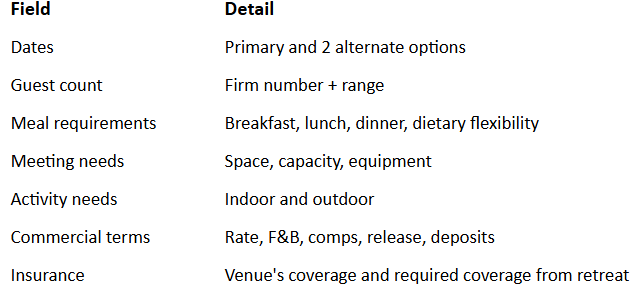
A professional RFP signals to the venue that you are a hospitality operator, not a first-time buyer. Venues negotiate differently with both.
Frequently Asked Questions
Should I book a venue I've never visited?
Only after a thorough video walkthrough, multiple references from past retreats, and a clear contract. A pre-arrival site visit is still strongly recommended for luxury-tier retreats.
What's a healthy venue cost as a percentage of price?
40–55% of gross revenue on a well-negotiated contract. Above 60% erases margin.
Should I use a destination management company (DMC)?
For international retreats in complex destinations, yes. DMC fees typically run 10–20% of venue cost but save significantly more in risk and logistics.
How far in advance should I book the venue?
Six to nine months for international. Four to six months for domestic. Peak-season venues book further out.
Can I negotiate after signing?
Rarely successful. Negotiate everything in the first contract.
Want a hospitality-grade venue negotiation walkthrough? Book a strategy call