How to Start a Profitable Retreat Business in 2026: The Strategist's Guide
How to Start a Profitable Retreat Business in 2026: The Strategist's Guide
Starting a profitable retreat business in 2026 is less about picking a beautiful venue and more about architecting a business model that protects margins from day one. The retreat leaders who build real revenue in their first year do five things before anything else: they define a bespoke positioning statement, set a profit-first price, choose a venue with margin math (not vibes), build a repeatable enrollment system, and design the guest experience around a measurable transformation. Skip any of these and you do not have a business, you have an expensive event.
What Is a Profitable Retreat Business?
A profitable retreat business is a repeatable infrastructure, not a single event, that generates predictable revenue, clear margins, and a guest experience built on hospitality-grade methodology rather than inspiration alone.
That definition matters because most first-time retreat leaders build an event, fall in love with the outcome, and then struggle to reproduce the result. A retreat business has pricing logic, a sales system, contracts, vendor relationships, a continuation offer, and a cost model that clears at least 30% net margin on every cohort. Everything else is a hobby.
The 7-Step Framework to Start a Profitable Retreat Business
1. Architect Your Positioning Before You Architect Your Program
Positioning is the one decision that determines every other decision — price, venue, guest, marketing channel. Most retreat leaders skip this step and try to be everything to everyone. That is the single fastest way to build an unprofitable business.
A strong retreat position answers three questions in one sentence: Who is this for, what transformation do they get, and why are you the only person who can deliver it? If you cannot say that in under 20 words, stop. Go back. Your sales page, your price, and your enrollment system all depend on it.
2. Build a Profit-First Price, Not a Market-Average Price
The most common pricing mistake is looking at competitors and subtracting 10%. That is not pricing, it is racing your competitors to an unprofitable finish line. Profit-first pricing starts at the margin, works backward through cost, and lands on a number that supports the life you want to live.
The math looks like this: decide the net profit per guest you need, add your fully-loaded cost per guest (venue, food, staff, marketing amortization, taxes, your time), and that is your price floor. Any number below that is a donation.
3. Choose a Venue on Margin Math
Venue contracts are where most profit goes to die. The beautiful property that costs $1,200 per room per night has to be offset by a price point that makes the math work, and if it does not, walk away. Negotiate on food and beverage minimums, complimentary upgrades, release clauses, and staff rooms. A hospitality-grade retreat business treats venue negotiation like revenue management, not hotel booking.
4. Install a Repeatable Enrollment System
"I'll just post it on Instagram and people will sign up" is not an enrollment system. A real system includes a sales page, an application or booking flow, an email sequence, a deposit structure, and a conversation or ceremony that moves guests from interested to committed. Retreat leaders who skip the system host one retreat, sell out through force of will, and burn out before the second.
5. Design the Experience Around a Measurable Transformation
Guests do not book retreats because they want a week in nature. They book because they believe they will leave different than when they arrived. The retreat leaders who produce outstanding client results work backwards from a specific, observable outcome and engineer every session, meal, and ritual toward it. This is what separates a profitable retreat business from a well-intentioned one.
6. Build the Continuation Offer Before the First Guest Arrives
The most profitable retreat leaders earn 60–70% of their lifetime revenue after the first retreat ends, through masterminds, memberships, private consulting, or a next-tier retreat. If you do not have the continuation offer ready before launch, you are leaving most of the business on the table.
7. Operate Like Hospitality, Not Inspiration
Every detail, the welcome kit, the check-in ritual, the dietary note on the menu card, the goodbye letter; signals the standard of the business. Guests pay a premium for the feeling of being cared for at a Ritz-Carlton level. This is the closest thing to a moat a retreat business has.
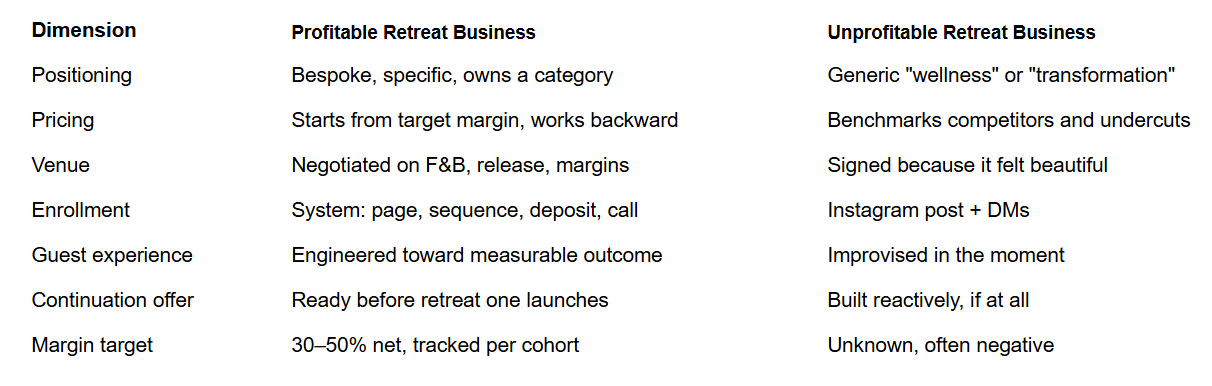
Profitable vs. Unprofitable Retreat Businesses: A Side-by-Side
Real Retreat Business Results
Brent McCann was on track to lose $10,000 on a men's retreat. One week into restructuring his model, a continuation offer added to the back end, a pricing reset, and a clearer enrollment path, the same retreat closed $17,000 in profit. A $27,000 swing from the same venue, same dates, same leader. What changed was the business architecture, not the event.
Frequently Asked Questions
How much money do I need to start a profitable retreat business?
Less than most people think, if the business model is built correctly. The minimum viable infrastructure, sales page, deposits collected before venue deposit, a small paid ad budget, can be started for under $5,000. The venue and operations are funded by guest deposits, not founder capital, when the enrollment system is in place first.
How many guests should my first retreat have?
Between 8 and 15 is the sweet spot for first-time retreat leaders. It is large enough to produce real margin, small enough to deliver hospitality-grade quality, and tight enough to generate the testimonials and case studies you need to fill retreat two.
Do I need to be certified to run retreats?
No certification is legally required to run a retreat. What you need is credibility in your specific domain, a clean contract, proper liability coverage, and hospitality-grade delivery. The Certified Retreat Planner™ credential is designed for retreat leaders who want a professional standard for the business side of the work.
How long does it take to fill a retreat?
With an existing audience, 60–90 days. Without one, plan for 120–180 days and build the enrollment infrastructure in parallel. The common mistake is compressing the timeline and then dropping the price to compensate.
What is the biggest reason first retreats fail financially?
Under-pricing driven by fear. Retreat leaders routinely charge 30–50% below what their position supports, then cannot absorb cost overruns or last-minute cancellations. Profit-first pricing is the single highest-leverage decision a new retreat leader can make.
Ready to architect a profitable retreat business instead of hosting one-off events? Save your seat in the free masterclass or book a strategy call with Leni.