Retreat Business Models Explained: Which One Is Right for You?
Retreat Business Models Explained: Which One Is Right for You?
There are four main retreat business models, leader-led retreats, retreat centers, hybrid programs, and retreat consulting. Most coaches, facilitators, and wellness professionals should start with the leader-led model: it requires the least capital, gets to revenue fastest, and can be built into a six-figure business without owning a single property. The right model depends on your goals, your existing audience, and how much risk you're willing to carry.
One of the most common mistakes new retreat leaders make is building the wrong business model for where they actually are in their journey.
They see a beautiful retreat center on Instagram and start calculating what it would cost to buy property. Or they try to run four retreats a year before they've proven demand for one. Or they design a premium mastermind retreat without the audience or track record to fill it.
The model you choose determines everything: your cash flow, your risk exposure, how much time you spend on logistics versus facilitation, and ultimately how long you can sustain the business. Getting this decision right early saves years of expensive course-correction.
I've worked across 100+ retreats with leaders at every stage, from someone running their very first weekend program to established retreat centers overhauling their operations. What I've seen consistently is that the most profitable retreat businesses are not always the most complex ones. They're the ones where the model matches the leader's strengths, capacity, and market position.
Here's a complete breakdown of every retreat business model, what each requires, and how to choose the right one for you.
What Is a Retreat Business Model?
A retreat business model is the structural framework that defines how you create, price, deliver, and generate revenue from retreat experiences. It determines who you serve, what you charge, how often you run programs, and what your revenue looks like between events.
The right model creates a sustainable engine for income and impact. The wrong model creates a cycle of exhausting launches, underpriced programs, and burnout, even when the retreats themselves are exceptional.
The Four Core Retreat Business Models
1. The Leader-Led Retreat Model
This is the most common model and the right starting point for the vast majority of coaches, therapists, facilitators, yoga teachers, spiritual leaders, and wellness professionals.
In this model, you design, market, and facilitate your own retreats. You rent a venue for the duration of the program, fill it with participants through your own marketing and sales efforts, and deliver the experience yourself. You own the entire business relationship with your participants.
How revenue works: You collect registration fees from participants, pay your venue and operational costs, and keep the profit. Revenue is event-driven, you earn when a retreat runs.
Typical revenue range: $5,000 to $100,000+ per retreat, depending on pricing, group size, and duration. Well-structured leader-led retreats with 10–20 participants at premium pricing routinely generate $20,000–$50,000 per event.
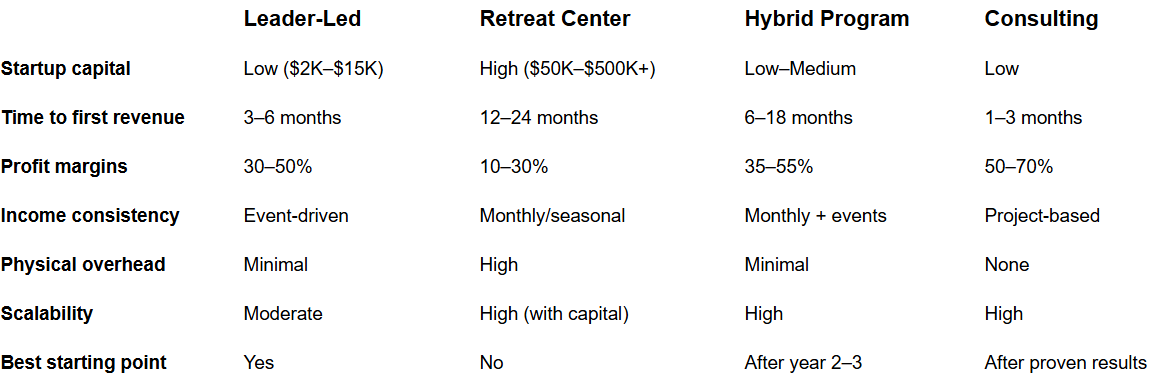
Profit margins: When properly structured, leader-led retreats achieve 30–50% net profit margins. The key word is "structured", retreats without deliberate pricing frameworks often break even or lose money despite selling out.
What it requires:
- A defined niche and transformation promise
- An existing audience or a plan to build one
- A pricing framework built for real margins
- A continuation offer to generate revenue beyond the retreat itself
- Marketing runway of 3–6 months minimum
Best for: Coaches, therapists, yoga teachers, spiritual facilitators, wellness professionals, and anyone building a personal brand-based business. This model works particularly well for people who already have an audience, even a small, engaged one, and who want to generate significant income without a large capital investment.
The honest trade-off: Your income is tied to your time and energy. Every retreat requires active marketing, facilitation, and operations. Without systems and team support, scaling becomes difficult beyond three to four retreats per year.
2. The Retreat Center Model
In this model, you own or long-term lease a physical property and use it to host multiple retreats, either your own programs, programs led by guest facilitators who rent your space, or a combination of both.
This is a fundamentally different business from the leader-led model. You're operating a hospitality business with real estate at its core.
How revenue works: Revenue comes from multiple streams, venue rental fees from visiting facilitators, your own retreat programs, accommodation, meals, day use, and potentially spa services, workshops, or wellness programming. The most resilient retreat centers generate 25–35% of revenue from diversified ancillary streams beyond room rental.
Typical revenue range: Highly variable. A small retreat center with 8–12 rooms in a domestic location might generate $200,000–$600,000 annually. Larger or internationally positioned centers can reach well into seven figures.
Profit margins: Industry data shows profit margins for retreat centers typically range from 10–30% depending on occupancy, operational efficiency, and revenue diversification. Centers that achieve strong repeat guest rates and diversified programming consistently outperform those relying on single-channel revenue.
What it requires:
- Significant startup capital ($50,000–$500,000+ depending on whether you're leasing or purchasing)
- Property management expertise or a strong operations team
- A marketing system to keep the calendar full year-round
- Understanding of hospitality operations, insurance, and compliance
- The ability to weather low-occupancy seasons financially
Best for: Entrepreneurs with capital and hospitality experience, or experienced retreat leaders who have built a strong following and want to create a home base for their community.
The honest trade-off: High overhead is the defining challenge. Even with a full calendar, a retreat center has fixed costs that don't disappear between retreats. Seasonal demand swings, last-minute cancellations, and economic downturns hit this model hard. Many retreat centers that look thriving from the outside are cash-flow constrained.
3. The Hybrid Program Model
This model combines retreat events with other revenue streams, online courses, membership communities, group coaching programs, private intensives, and digital products, to create a year-round income engine where retreats are a premium offering within a larger ecosystem.
This is where the most financially resilient retreat businesses tend to operate.
How revenue works: Multiple concurrent income streams reduce dependence on any single event. A retreat leader running this model might have a monthly membership or group program generating recurring revenue, with one or two annual retreats as flagship high-ticket experiences for the community.
Revenue example: A retreat leader with 150 members paying $200/month generates $30,000/month in recurring revenue, $360,000 annually, before running a single retreat. Two annual retreats at $15,000–$30,000 profit each add $30,000–$60,000 on top. Total: $390,000–$420,000 with manageable workload and predictable cash flow.
What it requires:
- A proven retreat model as the foundation
- An engaged audience that trusts your leadership
- A digital infrastructure for delivering online programs
- A clear customer journey from first touch to flagship retreat
Best for: Experienced retreat leaders who have run multiple successful events, built a community, and are ready to create income stability between retreat launches.
The honest trade-off: This model takes the most time to build. You need a proven retreat first. The online program component requires different marketing and delivery skills than in-person facilitation. Many retreat leaders overcommit to building the hybrid model before establishing a financially solid retreat foundation.
4. The Retreat Consulting and Strategy Model
In this model, your expertise in retreat design, marketing, and operations becomes the product. You advise, consult for, or coach other retreat leaders, helping them build profitable programs, fix broken business models, or launch their first retreat.
How revenue works: Revenue comes from consulting retainers, strategy intensives, group programs, online courses, or licensing your methodology. This model is location-independent and highly scalable.
What it requires:
- A proven track record running or advising on profitable retreats
- The ability to articulate and teach your methodology
- A reputation that attracts clients seeking your expertise
Best for: Experienced retreat professionals with a distinctive methodology and strong results to point to.
The honest trade-off: Credibility is everything in this model. Trying to consult on retreat profitability without a proven track record is a short path to an empty calendar.
Comparing the Four Models Side by Side
How to Choose the Right Model for Where You Are Now
The right model is not the most impressive one, it's the one that generates real income at your current stage.
If you are just starting out: Start with the leader-led model. One well-structured retreat with 8–12 participants can generate $10,000–$30,000 in profit. Prove the model, build your methodology, gather testimonials, and understand your market before adding complexity.
If you have run 2–3 successful retreats: Start layering in the hybrid model. Build a community around your work, a membership, a group program, or an email list with a nurture sequence, so you are not starting from zero every time you launch a retreat.
If you have 5+ years of retreat experience and capital: The retreat center model may be viable. But approach it like a hospitality investor, not a retreat leader who wants a beautiful space. Model your occupancy, your fixed costs, and your break-even before signing a lease or purchasing property.
If you have proven results and a distinctive methodology: The consulting model can be highly lucrative and personally fulfilling. But your results need to speak for themselves. Invest in building your reputation before building your consulting practice.
The Revenue Streams Most Retreat Leaders Overlook
Regardless of which model you choose, the leaders who generate the most revenue from retreats are not necessarily the ones running the most retreats. They are the ones who have built multiple revenue streams around each retreat event.
The most overlooked, and highest-impact, revenue stream is the continuation offer: a program, mastermind, private coaching package, or membership that participants can join directly after the retreat. Participants who just completed a transformational experience are at their highest level of motivation and trust. A well-designed continuation offer converts a significant percentage of attendees into ongoing clients.
One client was projecting a $10,000 loss on her retreat. After restructuring her pricing and adding a continuation offer, that same retreat generated $17,000 in profit, and launched a mastermind program that became her primary revenue engine for the following year.
Other high-value revenue streams to build into your model:
- Tiered pricing, Early bird, standard, and VIP tiers with different levels of access, private sessions, or accommodations
- Add-on experiences, Private coaching sessions, extended stays, exclusive dinners, post-retreat integration calls
- Retreat recordings or digital programs, Capturing retreat content in a format that generates passive income
- Waitlist monetization, Building waitlists for future retreats and converting them between events
Common Mistakes When Choosing a Retreat Business Model
Copying what looks successful from the outside. A retreat center that photographs beautifully may be operating at a loss. A retreat leader with a large social media following may be struggling to fill programs. Build your model on real financial data, not aesthetics.
Starting with the most complex model. The retreat center and hybrid models are not better than the leader-led model, they are more complex. Complexity is only an advantage when you have the foundation to support it.
Underestimating the marketing requirement of every model. Every retreat business model lives or dies on its ability to fill programs consistently. Marketing is not optional, and it is not secondary. Build your marketing system first.
Ignoring the continuation offer. In over a decade of working with retreat leaders, the single most consistent profit driver across every model is a well-designed continuation offer. If you are not building this in from the start, you are leaving significant revenue uncollected.
Frequently Asked Questions
What is the most profitable retreat business model?
The leader-led model with a strong continuation offer consistently delivers the highest profit margins, 30–50%, for independent retreat professionals. The hybrid model adds income stability once a proven retreat foundation is in place. Retreat centers can be highly profitable but require significant capital and hospitality expertise to operate well.
Can you run a retreat business without owning a venue?
Yes. The leader-led model requires no property ownership. You rent venues for the duration of each program, which keeps overhead minimal and allows you to test locations and formats before committing long-term. Many six-figure retreat businesses operate entirely through rented venues.
How many retreats should I run per year?
One to two well-structured, fully sold-out retreats per year is a stronger starting point than four underfilled retreats. Quality of execution and profit per retreat matters more than volume. Experienced leaders running a hybrid model can sustainably run three to four events per year with strong systems in place.
What is a continuation offer in a retreat business?
A continuation offer is a program, service, or community that participants can join immediately after the retreat. It captures the momentum of a transformational experience and converts it into ongoing revenue. Common formats include masterminds, group coaching programs, memberships, and private intensive packages.
When should I transition from leader-led retreats to a hybrid model?
Transition to the hybrid model when you have run two to three profitable retreats, built an engaged audience, and identified what your participants want to do after working with you. The hybrid model is built on a proven retreat foundation, not a replacement for one.
The retreat industry is one of the most meaningful ways to generate significant income around your expertise and your gifts. But the model matters as much as the work itself.
Most retreat leaders should start with the leader-led model, prove their concept, and build from a position of financial strength. The complexity of retreat centers, hybrid programs, and consulting practices is most rewarding, and most profitable, when it sits on a foundation of real results and tested methodology.
Whatever model you choose, build it with the same rigor that the world's best hospitality brands bring to their operations. Transformation and profitability are not opposites. They are the foundation of a retreat business that lasts.
If you want help identifying which model is right for your specific situation, and building the business architecture to support it, book a strategy call at https://theretreatplanner.com/call or join the free Sold Out & Profitable Masterclass at https://theretreatplanner.com/challenge.