
Retreat Contracts: What You Need in Writing
Retreat Contracts: What You Need in Writing
A retreat business runs on four contracts: guest agreement, venue contract, vendor agreements, and staff terms. Skip any of them and one bad cohort can wipe out years of profit. This is the hospitality-grade checklist of what needs to be in writing, and why.
What Are Retreat Contracts?
Retreat contracts are the written agreements that govern the financial, legal, and operational relationships between the retreat business and everyone involved in delivering the retreat, guests, venues, vendors, and staff.
The 4 Contracts Every Retreat Business Needs
1. Guest Agreement
The contract between the retreat business and each guest. The single most important document in the business.
Must include:
- Dates, venue, and included services
- Price and payment terms
- Non-refundable deposit clause
- Refund and cancellation policy
- Transferability language
- Medical emergency exception
- Force majeure clause
- Assumption of risk and waiver
- Code of conduct and grounds for removal
- Photo and testimonial release
- Governing jurisdiction
2. Venue Contract
The contract between the retreat business and the hosting property. Negotiated section by section.
Must include:
- Dates, rooms, and capacity
- Rate, F&B minimum, and complimentary rooms
- Deposit schedule and payment timing
- Release clause for under-filled cohorts
- Cancellation and force majeure terms
- Liability and insurance requirements
- Damages and security deposit
- Governing law
3. Vendor Agreements
Every vendor, transportation, photographers, facilitators, chefs, translators, needs a written agreement.
Must include:
- Scope of work
- Dates and deliverables
- Fee and payment timing
- Cancellation terms
- Liability and insurance
- Confidentiality if relevant
- Intellectual property ownership (especially for photographers)
4. Staff and Co-Facilitator Agreements
Anyone delivering on-site, retreat managers, assistants, co-leaders, needs clear written terms.
Must include:
- Dates, role, and hours
- Compensation and payment timing
- Travel and accommodation coverage
- Non-disclosure or non-compete if applicable
- Code of conduct
- Termination clause
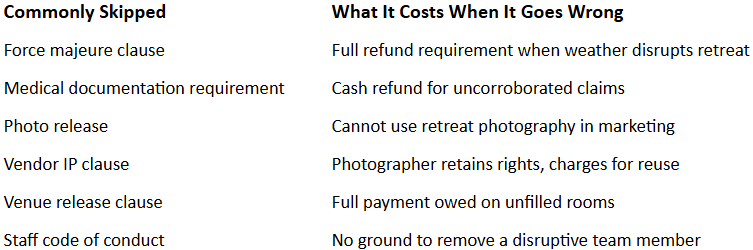
What Gets Skipped (And Why It Matters)
How to Get Contracts Drafted
1. Template base from a hospitality-experienced attorney. One-time cost $800–$2,500. Reused for years.
2. Update per cohort. Dates, prices, venue change. Core terms stay the same.
3. Review annually. Laws and business change. Re-review every 12 months.
4. Electronic signature. Use HelloSign, DocuSign, or Dubsado. Never rely on email confirmation alone.
Frequently Asked Questions
Can I use a template from the internet?
Only as a starting point. Every retreat business needs a one-time attorney review of its template, customized to jurisdiction and business structure.
How much does legal setup cost?
Budget $1,500–$4,000 for the initial full set of contracts. This is a one-time cost that protects the business for years.
Do I need international legal advice for international retreats?
For most international retreats run from a US or EU base, domestic contracts with clear jurisdiction language are sufficient. For complex situations (live in country, tax implications), engage local counsel.
Should guests sign in advance or on arrival?
In advance, at the time of deposit. Arrival-day signing creates friction and is legally weaker if a dispute arises.
What happens if a guest refuses to sign?
The deposit is refunded and the seat is released. No signed agreement, no retreat. This is non-negotiable.
Need hospitality-grade contracts for your retreat business? Book a strategy call.