The Retreat Industry Is Broken — Here's What Comes Next
The Retreat Industry Is Broken, Here's What Comes Next
The retreat industry is broken, not because demand is weak, but because supply is built on inspiration rather than infrastructure. Too many retreat leaders architect an experience without architecting a business, and the result is a market full of beautiful events run by people who cannot afford to run them. What comes next is a hospitality-grade standard: retreat businesses built on the same margin math, operational rigor, and brand discipline as Ritz-Carlton or Relais & Châteaux. This is the case for that shift, and what it looks like.
What Does "Broken" Mean?
A broken industry is one where the gap between the experience customers buy and the businesses delivering them produces systemic financial failure. In the retreat category, that gap is wide and getting wider.
The 4 Signs the Industry Is Broken
1. Most Retreats Lose Money
Conservative estimates suggest 60–80% of retreats produce zero or negative net margin after all costs, including founder time, are accounted for. No other premium hospitality product operates at that failure rate.
2. "Coaching" Has Replaced Strategy
The dominant language in the retreat space is coaching, not consulting, not strategy, not architecture. The effect is to treat retreat business-building as personal development rather than professional operation. Coaching has its place, but a business model cannot be coached into existence.
3. Inspiration Over Infrastructure
The assets most retreat leaders prioritize, beautiful photography, evocative copy, aspirational branding, are the assets of an experience, not a business. Infrastructure (contracts, pricing models, margin math, enrollment systems) is treated as secondary or optional.
4. The Founder Is the Business
In a healthy industry, the business can operate without the founder in the room for every decision. Most retreat businesses cannot. When the founder takes a break, the business stops. That is not a business, it is a high-leverage job.
What Hospitality-Grade Looks Like
The next standard in the retreat industry is not bigger retreats or lower prices. It is hospitality-grade operation borrowed from the sectors that have already solved premium experience delivery at scale: luxury hospitality brands.
Margin Math Before Inspiration
Every decision, venue, pricing, guest experience, runs through a margin filter. Inspiration sets the vision; margin math protects it.
Bespoke Positioning, Not Category Sameness
Every profitable retreat business owns a specific category of guest, transformation, and delivery, not a generic wellness or transformation angle.
Contracts, Not Good Faith
Every relationship, with guests, venues, vendors, and staff, is in writing. The absence of a contract is not warmth; it is unprofessional exposure.
Continuation Offers, Not One-Off Events
The retreat is a single revenue stream inside a multi-stream business. Masterminds, consulting, certifications, B2B work, all feed the retreat and are fed by it.
Founder Compensation as a Cost Line
The founder gets paid before the business gets its net profit. This is how hospitality brands have always operated, and it is what separates a business from a labor-of-love.
The Market Signal
The retreat businesses that will define the next five years are already visible. They are run by leaders who used to work in hospitality, corporate strategy, or executive consulting, and who brought that rigor into a category that needs it. They price higher, deliver better, and earn more from fewer retreats. Their guests do not miss the old version. The market is reorganizing around the new standard.
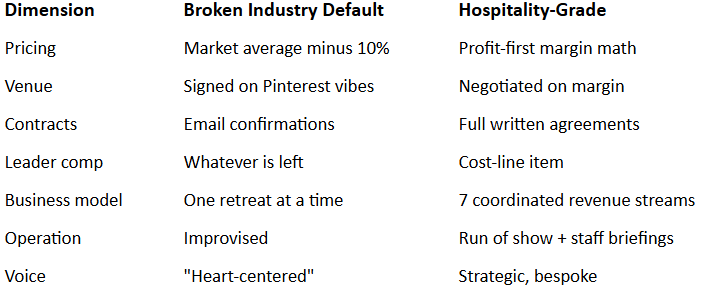
Broken vs. Hospitality-Grade: Side by Side
Frequently Asked Questions
Is the retreat industry going to collapse?
No, demand is growing. What will collapse is the category of retreats run without business infrastructure. The hospitality-grade tier will grow.
Do I have to be corporate-trained to run a hospitality-grade retreat business?
No. You have to be willing to adopt the methodology. Many of the most rigorous retreat businesses are run by former yoga teachers, coaches, and facilitators who decided to build like hospitality operators.
Will higher prices push guests out of the market?
No, premium retreat buyers are insulated from most macro pressure, and hospitality-grade positioning increases trust rather than reducing it. Lower-priced retreats lose more demand, not less.
Is this shift happening worldwide or just in the US?
Worldwide. The hospitality-grade standard is more visible in European retreat markets, but US and Latin American markets are catching up quickly.
How do I position my business on the hospitality-grade side?
Start with the brand voice, pricing, and contracts. The three are connected. When all three signal professional operation, the rest of the positioning follows.
Ready to architect a hospitality-grade retreat business? Save your seat in the free masterclass