The Retreat Sales Page: 12 Sections That Convert
The Retreat Sales Page: 12 Sections That Convert
A retreat sales page that converts high-intent buyers contains 12 specific sections, in a specific order, that mirror the actual buying psychology of a premium retreat guest. Skip any of them and the page loses qualified buyers in silence. This is the hospitality-grade structure.
What Is a Retreat Sales Page?
A retreat sales page is a single long-form page whose only job is to move a qualified buyer from consideration to deposit, not a marketing brochure, not a landing page, not an Instagram bio.
The 12 Sections
1. Hero: Positioning Headline + Subheadline
One line that says exactly what the retreat is, for whom, and what transformation it produces. No clever wordplay. No vague promise.
2. The Problem, In the Guest's Language
Three to five lines that describe the specific situation the buyer is in, using their own words. This is where customer research pays off.
3. The Promise
The specific outcome the retreat produces. Not "transformation", a tangible, observable result.
4. Who It's For (and Who It's Not)
A short qualifying list. Tells the wrong buyer to leave. Reassures the right buyer that the page was written for them.
5. The Experience (Day-by-Day or Arc)
A narrative walkthrough of the retreat itself. Arrival, signature moments, delivery, integration. This is the hospitality section.
6. The Venue, With Real Photography
High-quality imagery of the actual venue. Not stock photography, not iPhone snaps. This single section can swing conversion by 20%.
7. The Leader / About
A short, credibility-forward bio. Not a life story, the specific experience and track record that qualifies you to run this retreat.
8. Social Proof: Testimonials and Case Studies
Real, specific, named testimonials. Ideally with outcomes attached ("I went from $10K loss to $17K profit"). Vague praise does not convert.
9. What's Included (and What's Not)
A clear, itemized list. Guests need to know exactly what their money buys. Ambiguity kills deposits.
10. Pricing and Payment Plans
The price, the payment plan, the deposit structure. No hidden "contact for pricing" unless the tier genuinely requires it.
11. Frequently Asked Questions
The real questions past buyers have asked: refund policy, arrival logistics, dietary needs, level of experience required. FAQs are where last-minute objections go to die.
12. Final Call to Action
One button. One action. No competing links. "Reserve your seat" or "Apply to join" ,not both.
Section Priority by Conversion Impact
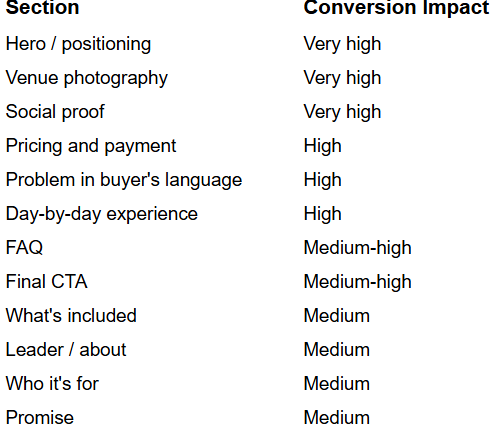
If you can only build five sections before launch, build hero, venue photography, social proof, pricing, and final CTA.
What Kills Retreat Sales Page Conversion
- Stock photography of smiling strangers
- Vague promises of "transformation" with no specific outcome
- Hidden price or "apply to learn more"
- Testimonials from people whose names and faces are not shown
- Multiple competing CTAs
- Copy written in the leader's voice instead of the buyer's
- Long blocks of dense text with no white space
Frequently Asked Questions
How long should a retreat sales page be?
Long enough to answer every qualified buyer's question, short enough that every section earns its place. Typically 2,500–4,500 words.
Should I gate the price behind an application?
Only for luxury tier (above $6,500) and only if the application genuinely qualifies buyers. For mid-tier and boutique, show the price.
Do video testimonials help?
Yes, significantly. Two to four 30-second video testimonials from past guests with named outcomes can lift conversion 15–30%.
Where should the price go on the page?
Approximately two-thirds of the way down, after the experience and social proof sections. Buyers who reach this point are already convinced on value and ready to evaluate price.
Can I use the same page for multiple cohorts?
Yes, update dates, pricing, and venue details per cohort. The core architecture stays the same.
Want a hospitality-grade sales page audit? Book a strategy call