Retreat Trends 2026: What Business-Owner Guests Actually Want
Retreat Trends 2026: What Business-Owner Guests Actually Want
The 2026 retreat market is reorganizing around business-owner guests, not wellness tourists. Demand is shifting toward smaller cohorts, higher price points, specific outcomes, and continuation offers that extend the transformation beyond the venue. Retreat businesses that build for this guest will outperform the wellness-first category by a wide margin. This is the landscape and the strategic implications.
Who Is the Business-Owner Guest?
The business-owner guest is a founder, operator, or executive attending a retreat for a specific professional outcome, clarity, strategy, network, skills, or transformation tied to their business. They are not seeking rest. They are seeking results they can take home.
The 7 Trends Shaping 2026
1. Smaller Cohorts at Higher Prices
The 20–30 person cohort is dying. Business-owner guests pay more for cohorts of 6–12, where the experience is personalized and the network is intentional.
2. Outcome-Specific Positioning
"A transformational week in Bali" is no longer enough. Business-owner guests book retreats that name a specific outcome, a launched offer, a restructured business, a clear 12-month plan.
3. Continuation Over Closure
The retreat is no longer the end of the journey. It is the beginning. Business-owner guests expect a structured continuation, mastermind, coaching, consulting, or next-tier retreat, that extends the transformation.
4. Premium Accommodation as a Baseline
The "shared room, rustic charm" aesthetic is losing market share to premium private accommodation. Business-owner guests expect hotel-grade rooms at minimum.
5. Operator-Led, Not Teacher-Led
Retreats led by operators, people who have run the business the guests want to build, are outperforming retreats led by teachers or facilitators without operator credentials.
6. Tight Agendas With Breathing Room
The contradiction business-owner guests want: every session has a purpose, and there is enough white space in the schedule to think. Compressed "cram every minute" retreats are losing to well-paced premium ones.
7. Private Advisory Built Into the Retreat
One-to-one time with the leader, 30–90 minutes of private advisory during the retreat, is becoming an expected feature at the premium tier.
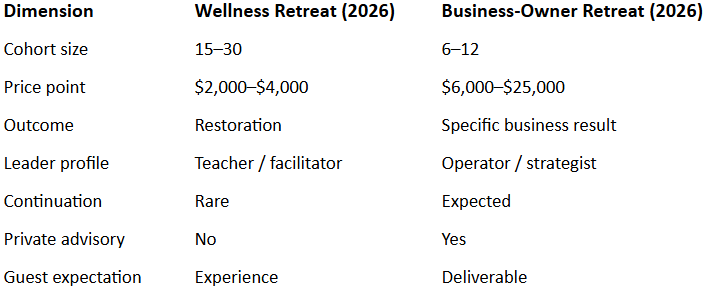
The Retreat Category Split in 2026
What This Means Strategically
Retreat leaders who want to grow in 2026 should architect for the business-owner guest: smaller, premium, outcome-specific, operator-led, with a continuation offer built in. The wellness tier is not dying, but it is saturated. The business-owner tier is growing and underserved.
The Demographic Shift
The highest-growth guest segment in the retreat category is women founders aged 35–55 running businesses between $250K and $5M in revenue. This segment is paying premium for retreats that combine strategy, network, and a break from the founder's home environment. Retreat businesses that serve this guest specifically are capturing outsized market share.
Frequently Asked Questions
Is wellness dead as a retreat category?
No, but it is saturated and increasingly commoditized. Business-owner retreats are where the growth and the margin are.
Can a former yoga teacher run a business-owner retreat?
Yes, if they bring business operator credentials or partner with someone who does. The guest buys on credibility, not just lineage.
Do I have to charge $10,000+ to serve this guest?
Not at first. Start at $4,500–$6,500 and raise price as positioning and proof accumulate.
Is this trend global or US-centric?
Global. European and Latin American markets are moving the same direction, sometimes faster.
Will AI change what retreat guests want?
Yes, it will increase the premium on in-person, trusted, transformational experiences. Retreats are one of the few products AI cannot replicate.
Ready to architect a business-owner retreat for 2026? Save your seat in the free masterclass